Pastel Retro Liquid Swirl Retro Waves: A Designer's Guide
Capturing the essence of a hazy sunset or a melted cassette tape, the aesthetic of Pastel Retro Liquid Swirl Retro Waves offers a distinct departure from the sharp, geometric precision often found in modern digital design. It is not merely a collection of colors; it is a visual language that communicates nostalgia, fluidity, and a dream-like quality. For creative professionals ranging from brand strategists to hobbyist crafters, understanding how to harness these swirling, soft gradients is key to creating visuals that resonate on an emotional level. This style leans heavily into the "vaporwave" and 80s revival trends but softens the edges with a contemporary, approachable palette.
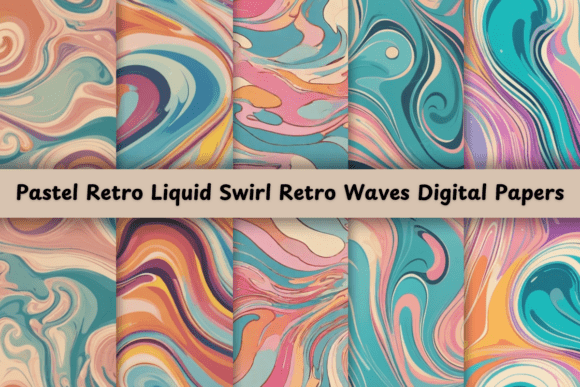
The visual characteristics of this style are defined by its seamless gradients and organic movement. Unlike static, flat design assets, the Pastel Retro Liquid Swirl Retro Waves patterns suggest motion. The color profiles typically feature soft pinks, muted teals, lavenders, and warm peaches, blending into one another without harsh lines. This creates a texture that feels tactile—almost like looking at oil mixing with water or the surface of a bubble. When used as a background, these patterns provide depth without overwhelming the foreground content, making them a versatile tool in a designer's arsenal.
Strategic Applications for Branding and Marketing
For entrepreneurs and small business owners, the challenge lies in translating this specific aesthetic into a viable brand identity. The Pastel Retro Liquid Swirl Retro Waves style works exceptionally well for brands targeting audiences interested in wellness, beauty, creative arts, or music. It conveys a sense of creativity and calm. However, applying it effectively requires restraint. If you are designing a logo, this typeface or pattern should likely serve as an accent or a background texture rather than the primary logomark itself, unless the brand name is very short and the contrast is high.
In packaging design, these textures can transform a mundane product into something that feels curated and artistic. Imagine a candle label or a skincare box where the background is a subtle, pastel swirl. It immediately elevates the perceived value of the product. For social media graphics, consistency is vital. Using these digital papers as a recurring background theme for Instagram stories or Pinterest pins helps in creating a recognizable "grid" that followers can identify instantly. The seamless nature of the patterns ensures that when you tile them or use them across different aspect ratios, the flow remains uninterrupted, maintaining a professional standard across all platforms.
Technical Considerations and Typography Pairing
While the aesthetic is fluid, your typography choices must be grounded. Because Pastel Retro Liquid Swirl Retro Waves backgrounds are visually complex and busy, they demand a typeface that offers high legibility. A bold, geometric sans serif font is often the safest bet here. The clean lines of a sans serif will cut through the soft chaos of the swirls, ensuring your message is read. Alternatively, a sturdy serif font can create a sophisticated, editorial contrast, mixing the organic nature of the background with the structured authority of the text.
Avoid using overly decorative script fonts or handwritten fonts directly on top of these dense swirl patterns. The visual noise can make the text illegible, forcing the reader to squint and reducing the effectiveness of your communication. If you must use a creative font, ensure it is placed within a container—such as a solid color block or a semi-transparent overlay—to separate the typography from the texture. This separation is crucial for visual hierarchy; the background should support the message, not compete with it.
Practical Implementation in Digital and Print
When you download a set of these assets, you are typically getting high-resolution files suitable for both screen and print. For web design, be mindful of file sizes. While the provided JPGs are high quality, you may need to optimize them for faster load times without sacrificing the gradient smoothness. Using these patterns as a hero background on a landing page can be incredibly effective for audience engagement, provided the text overlay is legible.
For print projects like invitations or scrapbooking, the 300 DPI resolution ensures that the gradients remain smooth and do not band. This is particularly important for the "liquid" effect; low-resolution printing can turn smooth gradients into stepping lines, ruining the illusion of fluidity. When using these for editorial design, consider using the pattern as a sidebar background or a pull-quote highlight rather than a full-bleed page background, which might be fatiguing to the eye over long reading sessions.
Choosing the Right Asset for Your Project
Evaluating the right fit involves looking at the specific color temperature of the swirl. Some variations lean cooler with blues and purples, while others are warmer with pinks and oranges. Match these tones to the emotion of your project. A cooler swirl might suit a tech blog or a meditation app, while a warmer swirl fits a fashion lookbook or a summer event invite.
Finally, consider the licensing. Most digital papers of this nature are designed for both personal and commercial use, but always verify the terms regarding print-on-demand services. If you are creating physical goods to sell, ensure the license covers the volume of sales or allows for derivative works. The versatility of Pastel Retro Liquid Swirl Retro Waves